


Why Do Guinea Pigs Chew Cage Bars? 6 Reasons and Safe Ways to Stop It
CLANK. CLANK. CLANK.
You walk into the room, open the refrigerator, or barely touch a veggie bag—and suddenly one of your guinea pigs is working the metal grids like a tiny, determined can opener.

So, why do guinea pigs chew cage bars?
Quick answer: Guinea pigs may chew cage bars because they are anticipating food, trying to reach another guinea pig, feeling frustrated, looking for something interesting to do, or repeating a habit that has worked before. Sudden or forceful bar chewing can also warrant a closer look at their health and teeth.
Occasional nibbling is not automatically an emergency. However, frequent, forceful, or suddenly new bar chewing deserves attention—especially if it is accompanied by reduced eating, drooling, mouth bleeding, weight loss, or a damaged tooth.
The goal is not simply to make the noise stop. It is to figure out what your guinea pig is trying to accomplish and address the reason behind the behavior.
What Does It Mean When a Guinea Pig Chews Cage Bars?
Bar chewing is sometimes described as an automatic sign that a guinea pig is unhappy, but research suggests the behavior is more complicated than that.
A 2025 study of 1,181 guinea pig caretakers examined relationships among housing, enrichment, social conditions, human interaction, and guinea pig behavior. Frequent bar chewing was relatively uncommon in the survey, but it was reported more often among guinea pigs housed in cages.
The researchers discussed several possible explanations, including frustration, food or attention anticipation, social conditions, and simply having bars available to chew. Importantly, the study found associations. It did not prove that one particular housing condition directly causes bar chewing.
In other words, bar biting is a clue, not a diagnosis.
One of the best ways to understand it is to pay attention to three things:
- When does your guinea pig chew the bars?
- Where in the habitat do they do it?
- What happens immediately afterward?
Those patterns can tell you quite a lot.
1. Your Guinea Pig Has Learned That Bar Biting Brings Food
This is one of the easiest patterns to recognize.
Your guinea pig may begin biting the bars when:
- You enter the room
- The refrigerator opens
- A bag rustles
- You approach the habitat
- Their usual vegetable or pellet time gets close
If food appears every time the chewing begins, your guinea pig can learn a very effective equation:
Bite bars → human appears → food arrives
That does not mean your piggy is being manipulative. It simply means they have discovered which behavior gets a response.
What can you do?
First, make sure your guinea pig always has access to fresh hay and working water. Never restrict hay in an attempt to discourage bar chewing.

For vegetables, pellets, treats, or attention, start rewarding a calmer alternative:
- Approach with the food as usual.
- Wait for a very brief pause in the bar biting—even one or two seconds at first.
- Deliver the food during that quiet moment.
- Gradually reward slightly longer periods of calm.
You can also establish relatively predictable feeding times so your guinea pigs are not constantly guessing when food will arrive.
This uses a basic principle of positive reinforcement: behaviors followed by something the animal values become more likely to happen again.
The idea is not to ignore your guinea pig’s needs. It is to make sure the behavior you want—such as pausing calmly—is the behavior that receives the reward.
2. They Are Trying to Reach Another Guinea Pig
Does your guinea pig always chew one particular wall or divider?
That location matters.
A guinea pig may bite the bars because another piggy is directly on the other side. They may want friendly contact, feel frustrated that they cannot reach the other pig, or even want to continue an argument.
Watch for patterns such as:
- Chewing only along a shared divider
- Following the neighboring guinea pig back and forth
- Rumbling, pacing, or teeth chattering near that section
- Losing interest when the other guinea pig moves away
Guinea pigs are highly social animals and generally benefit from appropriate companionship from other guinea pigs. You can read more about this in our guide to why guinea pigs should not be kept alone.
However, guinea pigs who have fought seriously or cannot safely live together should not have a necessary divider removed just to stop bar chewing.
What can you do?
If your guinea pigs may be compatible, learn about proper introductions and bonding before simply placing them together. A knowledgeable guinea pig rescue or guinea-pig-experienced veterinarian may be able to help you evaluate the situation.
If they need to remain separated:
- Make sure each guinea pig has their own hay, water, hiding places, and other essential resources.
- Consider adjusting the divider arrangement if they are constantly fixating on one another.
- Make sure a lower-ranking guinea pig can move away instead of being trapped beside the divider.
- Do not remove a divider that is preventing fighting or injury.
If you add a visual barrier to one part of a divider, make sure it is secure, chew-safe, and does not restrict necessary airflow. Ventilation is especially important because poor airflow can contribute to ammonia accumulation. You can learn more in our guide to ammonia and ventilation in guinea pig habitats.
The right solution depends on whether your guinea pig is seeking friendly companionship, reacting territorially, or simply becoming frustrated by something interesting being just out of reach.
3. Their Habitat Is Too Small or the Layout Feels Frustrating
Bar chewing by itself does not prove that a habitat is too small.
Still, guinea pigs need enough usable horizontal space to run, explore, choose where to rest, and move away from one another.
A habitat can technically meet a recommended measurement while still feel cramped if too much of the floor is blocked by oversized hides, bowls, ramps, or other accessories.
Ask yourself:
- Is there an open path where the guinea pigs can run?
- Can every pig reach hay and water without being blocked?
- Are there enough hiding places and resources for everyone?
- Can a lower-ranking pig move away from a more dominant one?
- Has your colony grown without the habitat growing with it?
- Is so much floor space occupied by accessories that little open space remains?
The RSPCA’s guinea pig environment guidance recommends providing sufficient space, hiding places, tunnels, enrichment, food, water, and opportunities to exercise and behave naturally.
If you are unsure whether your setup provides enough usable room, we have also put together a complete guide to choosing the right guinea pig habitat size.
Sometimes, increasing the habitat size helps. In other cases, removing unnecessary clutter and improving the layout can make the existing space much more usable.
4. They Need More Opportunities to Forage and Explore
Enrichment does not have to mean filling every inch of your guinea pig’s habitat with brightly colored plastic toys.
For guinea pigs, some of the best enrichment encourages natural behaviors such as:
- Foraging through hay
- Walking through tunnels
- Investigating boxes and shelters
- Searching for small portions of food
- Gnawing safe materials
- Choosing between open and covered spaces
Try rotating a few simple activities:
- Cardboard boxes with safe entry and exit holes
- Cardboard tunnels
- Loose piles of fresh hay in more than one location
- Hay tucked inside a plain cardboard box
- Pellets or vegetables scattered through clean hay
- Untreated willow or other guinea-pig-safe sticks
- Untreated wooden chew toys intended for guinea pigs
- A rearranged layout with a clear running route
Rotate items instead of placing everything in the habitat at once. Too much enrichment can become clutter, leaving your guinea pigs with less room to move.
The goal is not necessarily to give your guinea pig more stuff. It is to give them more opportunities to do guinea pig things.
5. Normal Chewing Has Been Directed Toward the Wrong Object
Guinea pigs naturally spend a large portion of their day chewing. Their teeth grow continuously, and the prolonged grinding action involved in eating grass hay is essential for normal dental wear.
That does not mean metal cage bars are a good dental tool.
If the bars are one of the most available or interesting chewing surfaces, a guinea pig may repeatedly use them even when safer options exist.
Start with the basics
- Keep fresh grass hay available at all times.
- Replace hay that has become damp, stale, or heavily soiled.
- Offer hay in more than one location if multiple pigs compete for access.
- Experiment with different ways of presenting hay, including large loose piles.
- Provide guinea-pig-safe untreated wood or willow for additional gnawing.
- Make sure hay racks are not difficult or uncomfortable to reach.
Hay is especially important because guinea pigs do not simply need something hard to bite. Their teeth benefit from the extended side-to-side grinding motion involved in chewing fibrous grass and hay.
If you are deciding which hay to offer, our guide explains the differences among first-, second-, and third-cut Timothy hay.
6. A Sudden Behavior Change May Need a Health Check
Bar biting alone does not mean that a guinea pig is sick or in pain.
However, a behavior that suddenly appears—especially when nothing obvious has changed in the habitat—should not automatically be dismissed as boredom or attention-seeking.
Guinea pigs are prey animals and can hide signs of illness surprisingly well.
Pay particular attention if the chewing is accompanied by:
- Eating less hay or refusing food
- Dropping food while chewing
- Chewing only on one side
- Drooling or a constantly wet chin
- Blood around the mouth
- A visibly broken, loose, uneven, or missing incisor
- Weight loss
- Smaller or fewer droppings
- Hiding more than usual
- Lower energy or an unusual posture
The Merck Veterinary Manual’s overview of common guinea pig health problems explains that dental disease can cause signs including difficulty eating, drooling, weight loss, and oral injuries.
If bar chewing appears alongside any of these symptoms, contact a guinea-pig-experienced exotics veterinarian.
Do not attempt to cut, file, or straighten a guinea pig’s teeth at home.
Can Chewing Cage Bars Damage a Guinea Pig’s Teeth?
This is where bar chewing can become more than an irritating noise.
An occasional exploratory nibble does not automatically mean an injury has occurred. The greater concern is repeated, forceful chewing—especially when a guinea pig grips a metal bar and pulls against it.
That type of behavior may create a risk of a tooth becoming chipped, fractured, loosened, or pulled out of its normal position.
Contact an exotics veterinarian if you notice:
- A broken or missing tooth
- Blood around the mouth
- A tooth suddenly sitting at a different angle
- Difficulty picking up or chewing food
- A reduced appetite
- Drooling or a wet chin
- Signs of mouth pain
Because guinea pigs need to eat consistently to keep their digestive system functioning normally, a meaningful reduction in food intake should always be taken seriously.
Try a Three-Day Bar-Biting Log
Before changing the entire habitat at once, spend three days looking for a pattern.
Each time the behavior happens, record:
- The time: Does it happen around meals, overnight, or throughout the day?
- The trigger: Did you enter the room, open the refrigerator, rustle a bag, or interact with another pig?
- The location: Is it always the front wall, one corner, or a shared divider?
- What happened afterward: Did your guinea pig receive food, attention, floor time, or access to something?
- Hay and water: Were both fresh and continuously available?
- Other behavior: Was there pacing, hiding, social tension, drooling, or reduced eating?
After a few days, the pattern may become surprisingly obvious.
Front wall + you enter + lettuce appears? Your guinea pig may have learned that bar biting summons the salad delivery service.
One divider + another guinea pig is standing there? Investigate social frustration or territorial behavior.
Frequent chewing + few opportunities to forage or explore? Take a closer look at enrichment and habitat layout.
Sudden chewing + changes in eating or behavior? Contact a guinea-pig-experienced veterinarian.
How to Stop a Guinea Pig From Chewing Cage Bars
Once you have identified the likely cause, you can work on the actual problem instead of simply trying to stop the noise.
1. Identify the trigger
Look for a consistent pattern before changing everything at once. When five things change on the same day, it becomes difficult to tell what actually helped.
2. Check their basic needs
Make sure your guinea pig has continuous access to hay and water, adequate usable space, appropriate companionship, hiding places, and opportunities to forage and explore.
3. Reward calm behavior
If your guinea pig chews the bars to summon food or attention, wait for a brief quiet moment before delivering the reward.
4. Change the environment
Rearrange a problematic divider, provide additional enrichment, increase usable space where necessary, or consider habitat walls that do not give your guinea pig a metal bar to grip.
5. Rule out injury or illness
Sudden, persistent, or forceful chewing—particularly when accompanied by appetite, weight, dental, droppings, or behavior changes—deserves veterinary attention.
What Not to Do When Your Guinea Pig Chews the Bars
As irritating as repeated bar chewing can be, punishment is not the answer.
Do not:
- Yell at your guinea pig
- Tap or bang on the habitat
- Spray your guinea pig with water
- Withhold hay
- Coat the bars in household products or homemade taste deterrents
- Remove a divider that is preventing incompatible guinea pigs from fighting
- Assume every case is simply boredom
The RSPCA’s guinea pig behavior guidance recommends quiet, gentle interaction and avoiding punishment.
Instead of asking, “How do I make my guinea pig stop doing this?”, try asking:
“What is my guinea pig getting, or trying to get, by doing this?”
That question usually gets you much closer to a real solution.
Would a Bar-Free Guinea Pig Habitat Help?
Sometimes, yes.
A guinea pig cannot chew a metal grid that is not there. Removing the physical target can therefore be a practical part of the solution, especially for a guinea pig who has developed a persistent habit of gripping and pulling cage bars.
However, changing the wall material should not replace investigating the underlying cause.
A guinea pig who needs more hay, more room, additional enrichment, companionship, or veterinary care may simply redirect their behavior if the actual need remains unresolved.
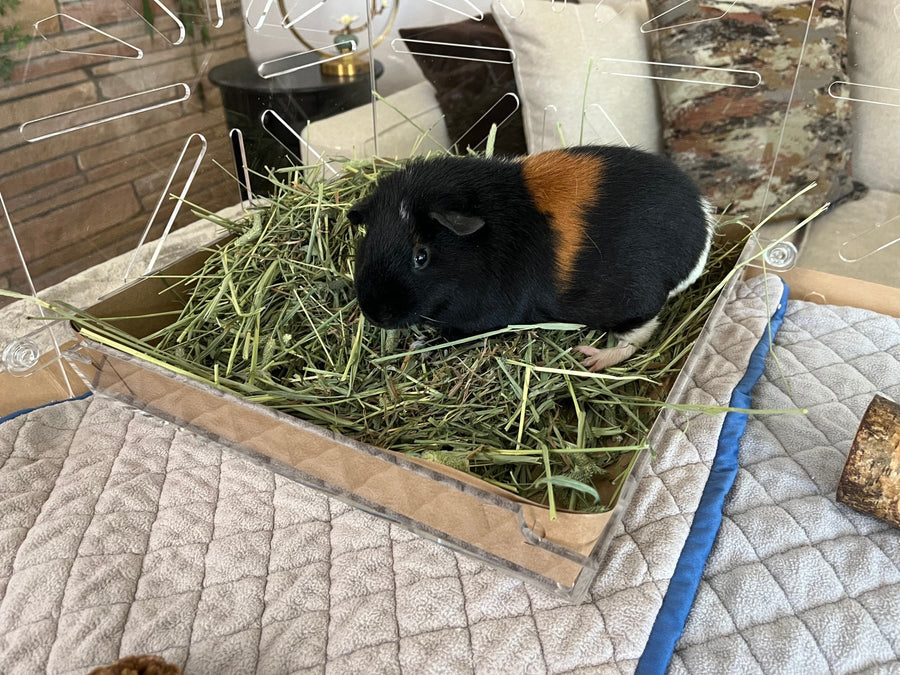
This is one of the reasons we designed the Guinea Colony Starter Kit differently from a traditional grid cage. Instead of exposed metal-grid walls, Guinea Colony uses clear acrylic tiles with built-in ventilation openings. Its modular structure can also expand as your colony—or its space needs—grows.
A bar-free habitat is not a substitute for meeting your guinea pig’s health and behavioral needs. But for a habitual bar chewer, removing the metal target can be one useful part of the solution.
Frequently Asked Questions
Why does my guinea pig bite the cage bars whenever they see me?
If bar biting begins as soon as you enter the room, your guinea pig may have learned to associate you with vegetables, pellets, treats, attention, or floor time.
Try waiting for a brief quiet pause before delivering the thing they are anticipating. Over time, this can reinforce calm behavior instead of bar biting.
Does cage-bar chewing mean my guinea pig’s habitat is too small?
Not necessarily.
Insufficient space can contribute to frustration, but bar chewing can also be related to food anticipation, social interactions, enrichment, habit, or other environmental factors.
Look at the entire pattern rather than using bar chewing alone as a measurement of habitat size.
Do guinea pigs chew metal bars to wear down their teeth?
Guinea pigs have continuously growing teeth and a natural need to chew, but metal bars are not an appropriate replacement for hay.
Constant access to good-quality grass hay is one of the most important parts of supporting normal dental wear.
Why does my guinea pig chew the bars at night?
Guinea pigs do not follow the same sleep schedule humans do. They are active at intervals throughout both the day and night.
Make sure plenty of fresh hay is available overnight and consider whether your guinea pig has safe opportunities to forage and explore.
If nighttime chewing appears suddenly or is accompanied by changes in eating, droppings, weight, or behavior, contact an exotics veterinarian.
Will switching to a bar-free habitat completely stop cage chewing?
It removes the metal bars themselves, so your guinea pig will no longer be able to perform that exact behavior.
However, it will not automatically solve hunger, social frustration, insufficient space, lack of enrichment, or a medical problem.
That is why it is important to understand why your guinea pig was chewing the bars in the first place.
The Bottom Line
Cage-bar biting is not a character flaw, and your guinea pig is not plotting to ruin your evening.
It is information.
Pay attention to when it happens, where it happens, and what happens afterward.
Once you identify the pattern, you can respond to the actual need, provide safer opportunities for natural guinea pig behavior, and avoid accidentally reinforcing the chewing.
Your home may become a little quieter—and your guinea pig’s teeth will be better off for it.
Sources and Further Reading
- Guinea Pig Welfare: Influence of Housing Conditions, Human–Animal Interactions and Enrichment — Animals, 2025
- Guinea Pig Environment and Enrichment — RSPCA
- Guinea Pig Behavior — RSPCA
- Guinea Pig Companionship — RSPCA
- Common Health Problems of Guinea Pigs — Merck Veterinary Manual
- Using Reinforcement and Rewards to Train Your Pet — VCA Animal Hospitals
This article is intended for general education and does not replace care from a guinea-pig-experienced exotics veterinarian.


Leave a comment